By DAWN HANKINS
dawn@richardsonmediagroup.net
During the Bedford County Board of Education meeting last Thursday, Commissioner John Boutwell, a former school board member, presented some pretty profound statistics, when it comes to per pupil spending in Bedford County.
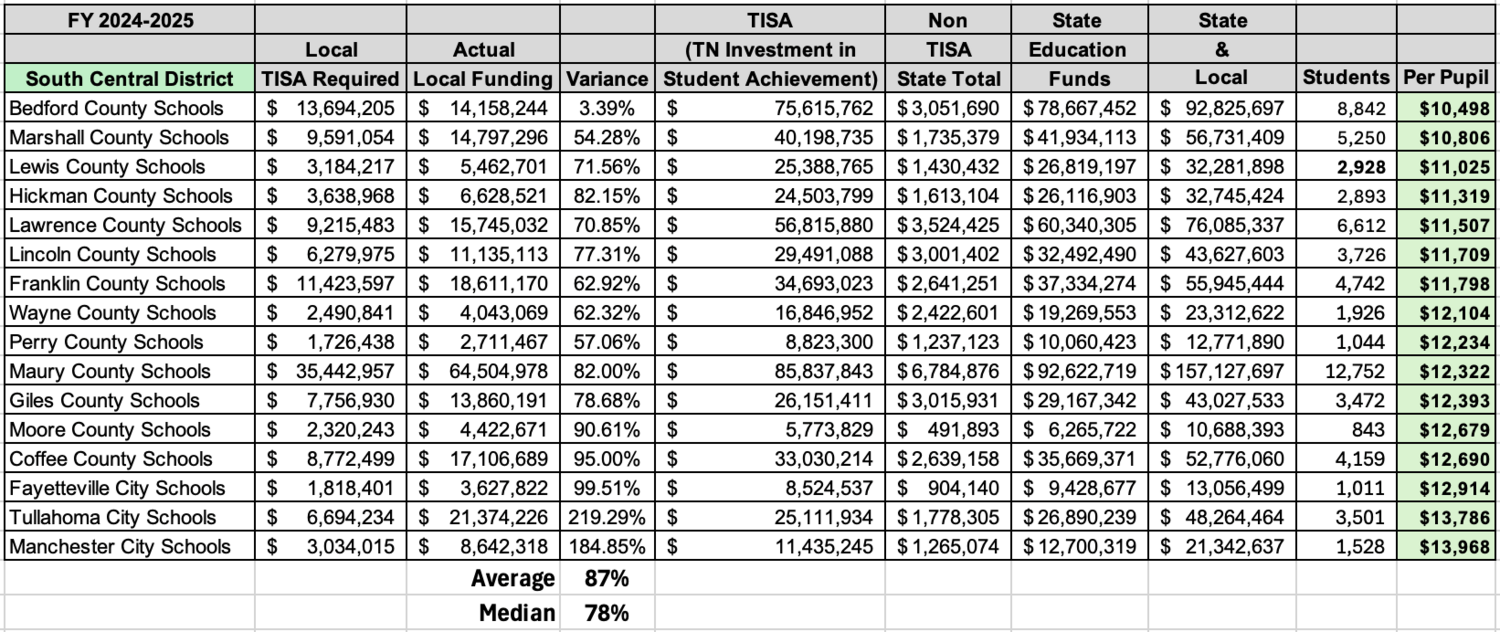
Basically, Bedford County ranks last in the South Central Core District and not much better overall in the state for what it spends on its students from the local budget. See the chart for comparisons in the South Central District.
Boutwell showed on his slide presentation how TISA matches up at the state level. The lack of funding he discussed, and has for years, is that Bedford County has slowly decreased its contributions for local education over the last 6 or so years.
He says he’s a “stats nerd” but he really is concerned about the digression of school-related spending. He would like to see this County do more than just the minimum.
Boutwell told the board that Bedford County only pays what is expected by the state, no more, no less. He advised that if it weren’t for the debt service fund the County has maintained, the state would likely reject the local budget.
Boutwell said debt service refers to the principal and interest payments made annually on the school bond indebtedness. Sort of like a house payment folks make out of their monthly income.
“The State using their education formula comes up with the dollar amount needed to educate children in each school district. Using an ability to pay sliding scale, the State tells the district their share of the cost. The district is expected to pay that amount and if they don’t then the State is supposed to withhold funding until the district comes up with the money.”
So far, that hasn’t happened.
Boutwell said in recent years, Bedford County has not budgeted its required portion. The State has looked the other way and continued funding.
“In FY 2025, the State allowed us to take credit for the bond principal and interest payment to bridge the gap…even though the debt service has nothing to do with the daily operation of schools.
“I look at it like this… a student lacks 2 points from getting a passing grade on the test, but the teacher gives the student 2 points for coming to school every day. The State is giving us credit for education spending even though the "extra credit" spending we are getting credit for has nothing to do with the formula determining how much is needed to educate our students.”
Boutwell said there’s a “wrinkle” in allowing the County to do this.
“The debt service is around 6 million and the State increased our maintenance of effort from $13 million to $19 million. When the loan payments decrease below 6 million, the County will have to honor the maintenance of effort and come up with the amount of the decrease below $6 million for the regular school operating budget.”
“My goal for the school board presentation was to inform the community on how we are funding our schools relative to other school districts in the State.”
The Gap in Local Commitment
Boutwell said the goal is to understand how Bedford County supports its schools relative to the rest of Tennessee. The data reveals a stark contrast: 92% of Tennessee school districts contribute at least 25% more than the State’s required minimum. Bedford sits in the bottom 8%. While Bedford is one of only 19 counties in the state with an improving "fiscal capacity" (our actual ability to generate revenue), our local funding for education remains stagnant.
The Human Cost of Stagnation
He reasons that education is, by nature, a labor-intensive endeavor. Funding levels directly dictate three critical factors:
• The number of teachers in our classrooms.
• The skill and experience mix of our faculty.
• Our ability to offer competitive pay.
“In any industry, overworked and underpaid employees lead to high turnover. Proficiency takes time to build; if we cannot retain our educators, we lose the institutional knowledge necessary for student success. We must ask our leadership: Is our current funding level creating a "revolving door" of talent?”
Boutwell worked professionally as a human resources leader.
He also explained to board members the The TISA Impact: Proof of Concept.
He said thanks to the state’s TISA (Tennessee Investment in Student Achievement) formula, the school system/County have seen what an injection of capital can do.
• 2023 State Funding: $57,441,287
• 2024 State Funding: $78,130,799
• Total Increase: $20,689,512
“With this $20 million increase, we have already seen improved teacher-pupil ratios and rising test scores. The correlation is undeniable: Investment yields results. Notably, the increase from the State alone was greater than Bedford’s entire local contribution for 2024. The State legislature clearly recognizes the value of this investment—the question is whether we do, too.
The Question of Priorities
“My intention is simply to inform,” said the commissioner. “Whether Bedford chooses to increase funding through tax adjustments or by reprioritizing existing revenue or do nothing different is a decision for the citizens. However, we must confront a difficult question: How do 91 out of 95 Tennessee counties manage to fund education at a higher relative rate than Bedford? While tax burdens vary, many of these counties operate with similar economic profiles to ours.”